Friday, March 6, 2015

Simple Steps To Keep Your Truck Tires From Eating Your Profits Alive

We know tires are expensive. We also know most drivers mean to keep up with their tire maintenance programs, but driving often gets in the way. Until you drop a tread, or pick-up a bolt, it's easy to forget about your tires. Problem is, tires are very unforgiving, and will eat up your profits any chance they get. Don't let them. Here's how.
Any tire showing damage is trying to tell you something. You might need an alignment if you see certain patterns, so knowing which tire patterns to look for helps you identify the problem. Tire sites usually have a chart on types of damage to expect with each problem.
Keep tires of the same diameter together (New with new. Used with used). If not, you end up with one tire skipping and scraping the road because it isn't the same size. Premature wear isn't pretty.
Know when to replace/retread your tires. Minimum legal depth is 4/32" on the steer and 2/32" on others. Tires wear at approximately 1/32" per 13-14,000 miles. Measure your treads now, and mark their expected replacement dates based on your average mileage. Problem solved.
Service those bearings and kingpins. This WILL make your tires wear better.Tire Maintenance
Always install new tires - not retreads, on your steering axles. Better safe than sorry when it comes to steering gear.
Make sure your inflation is correct for your load.Underinflated tires, especially under load, will chew tires quickly.
Adjust pressures for cold climates you are driving in. If you're coming from a warmer area, when you hit cold weather areas the air in your tires contracts, and suddenly you're running underinflated. Check your pressures.
Damaged, improperly balanced wheels will damage tires.Look over all of your wheels for signs of damage - every trip.
Keep radials with radials, and bias ply with bias ply. Don't mix them, or you will see a shorter tire life.
Tires do have a maintenance schedule. Whether you're a single O/O, or have a fleet of trucks, have a plan for replacement and/or repair with an escrow fund and based on mileage and you'll keep those tires from eating your profits alive.

Tuesday, December 30, 2014

Protect Your Investment. Winterize your Rig

It's that time of year, yet again - time to winterize your rig. And while the below is by no means a comprehensive list, it is a good way to start your winterization plan.
One of the few things typically taken care of for you is your fuel blend. You already know that your truck can be harder to start in winter, and to combat this, fuels are blended with 1D and 2D types of diesel for faster ignition. In spite of that, you'll still want to check the cetane number (CN). The higher the better in winter, as it's a measure of how quickly the fuel ignites. That said, let's get to the list you do have to worry about:
Hoses, radiator and belts - In the warm months, rubber and plastic might work perfectly well, but cold weather will test all of these components. Before it gets cold, check for small cracks, rub marks or bulges that can lead to a failure down the line. It may not happen today, but parts will fail at the least convenient moment, and keep you from making money. Change them if they look even the slightest bit suspicious.
Anti-freeze - Have your anti-freeze tested before the winter sets in. You need it to be at the best possible freeze point for the entire season. If you don't remember the last time you had it changed, it's probably time.
Batteries - When was the last time you had your batteries tested? If your batteries are between 4 and 6 years old, you need to consider replacing them before the season even begins. If they're younger than that, you still need to have them tested - under load.
Engine components - Check to see what type of equipment you have to make your rig start easier in the colder climates. If you have a block heater, intake pre-heats or glow plugs; make sure they are functioning correctly before you really need them.
Anti-gelling additives - As the name implies, this keeps your fuel from gelling in the cold temperatures. Use them.
Fuel/water separator - keeping water out of your fuel is always a good idea, but even more critical in the winter when it can freeze a fuel line. If you don't have one, get a fuel water separator for your rig. Minimize the amount of condensation that can collect by fuelling late in the day, if possible.
Air Dryers - Your break systems are designed to use dry air. In freezing temperatures, water/fluids can create an ice blockage and prevent your breaks from functioning. Air dryers help prevent that from happening. The air dryer sits between compressor and the wet tank, and should have the filter changed before the winter begins. Don't forget to drain your reservoirs periodically, as well.
Heating - When you check the in-cab heat systems, or open the valve - in some older trucks; change your in-cab filter, as well. You wouldn't believe what gets stuck in those filters over time. This contributes to slow cabin air, and can make it less comfortable for you in the colder climates.
Wiring - Like your battery, wiring is critically important to monitor. Rubbing, and exposure are two things that are tough on your wiring. Check all the areas you can for damage. Anywhere wiring touches another component is where you need to heavily scrutinize.
Sometimes you can do all of the above and still run into trouble on the road. You need prepare for this, as well. Keep extra blankets, water, food and survival supplies in your truck at all times. It takes up some precious room, but when you need it, it's well worth the space.
Keep rolling. Keep safe.

Tuesday, December 16, 2014

Are You Really Prepared For The Economic Upturn?

It’s coming to a trucking business near you. You’ve felt it creeping up on you for any number of months, but now it seems like it’s right in your face. The economic upturn is going to make your life a wreck if you’re not prepared.

So what’s the big deal about the economic upturn in the trucking industry? Remember those days when you had to cut back, and scrape for loads? Remember all the maintenance you had to let go until you could afford it, or the equipment you didn’t buy because it didn’t make sense at the time? You lost money then, and now you’ll lose more 20141104_154731 Stampmoney if you’re not prepared to take advantage of the opportunities available.
What’s going to hold you back? Unless you kept and maintained all of your equipment and drivers from 2010, you’re probably going to be lacking the resources to tackle all the loads you can. The good news is that you’re not the only one. The bad news is that you’ve got some catching up to do. Fortunately, everyone else is in the middle of getting caught up, as well. The longer you put it off, the less revenue you’re going to be bringing in later.
Perform maintenance
Where to start? Maintenance and updates are always the beginning. Bring your existing equipment up to spec, and update how you track your maintenance, your drivers and loads. Without proper maintenance, your fleet dies a lingering, costly death. Some states won’t even let you across their border without certain equipment, so there’s real incentive to make that maintenance happen.
Without proper tracking of your field assets, you have no way to determine where your potentially blossoming profits are spent. Additionally, before you can even consider new equipment, you have to have a way to make sure your existing equipment is being used in the most efficient manner possible. Adding equipment doesn’t just20141104_154300 Cropped Stampedadd capacity, it adds maintenance and man hours.
Update your equipment
The industry, and electronics have improved dramatically since 2010. Electronic logging makes tracking HOS easier, as well as determining when your drivers need to rest. Other computer and phone applications make it easier to find the cheapest diesel in an area, certified CAT scales and rest stops on the road. Look into these if you’re not using them. Additionally, look for an expense tracking software suite. You need to be able to drill down to any expense, anywhere in your fleet.

Wednesday, December 3, 2014

Fifth Wheel Maintenance


OK, so how many of you are thinking about your fifth wheel right now? Probably not many, right? Well like everything else on your truck, it needs maintenance. Which means you also probably need a checklist to do it right. Everyone loves a checklist, and we've got you covered.

1)      First, you're going to need to clean the gunk off that fifth wheel. Some folks go so far as to steam clean it; others simply scrape and clean it with a brush and solvent. You should know that it is recommended that you steam clean not only the top plate, but the jaws and legs, as well.

2)      Next you're going to inspect the upper area and edges for any damage. This can simply be wear and tear, or something more excessive - like missing parts or cracks. You're going to need to find a straight edge, too, because you've got to check the flatness of the fifth wheel. Cracks are obviously bad, as well. Finding them can be tricky if you're not steam cleaning the fifth wheel, but if you check underneath it, you can see any grease making its way through a crack.

3)      Look at the jaw area. Is there any damage, or excessive wear? You should have a test pin from your manufacturer. You're going to use this to engage the locking mechanism. Check the release handle, as well. This needs to be straight and secure. Look for any missing parts. Adjust the locking mechanism.

4)      You'll want to examine the bracket pins and legs for any type of damage (slack, wear or cracks).

5)      Check those Zerks. Obviously, grease fittings should be intact and unclogged.

6)      This is the point where you're going to need the square. Review the flatness of the bolster plate, as well as the kingpin. You're looking for any deformities in either one. No one likes it, but when you find damage in either one, you're going to need to replace it.

7)      Check your kingpin for wear, as well. You're going to need a kingpin gauge for this. 

8)      Now that you've made it through the inspection, hopefully without needing to replace anything, it's time to look at the necessary maintenance. First, lubricate the jaw and locking mechanism. You're going to do this with a silicone based spray lube, or some other light oil.

9)      Let's give the zerks something to do now. You're going to use the grease gun for the bracket pin zerks to lube the surfaces above the pin.

10)   Now for the top plate. While many drivers and mechanics apply high quality grease all over the fifth wheel, you only need to grease the rear part, as the action of connecting a trailer will apply the grease to the rest of the fifth wheel.

Note: Not all of these steps apply if you have a fifth wheel with a Teflon disc. The disc is the lubricant.


Monday, December 23, 2013

How Are Your Driving Skills At 100+ Miles Per Hour?


It’s cold and absurdly early on this Las Vegas morning, but 30+ people couldn't be happier. Not just because it’s Vegas, but because East Coast Truck and Trailer Sales is hosting their Richard Petty Driving Experience again. If you’ve never been, the Richard Petty Driving Experience is a thrill ride you control - starting at 100+ mph!

Every year, the folks at ECTTS ask a number of their friends and customers to come out for the driving experience of a lifetime. This is a chance to drive a car as fast as you can – without any fear whatsoever of a ticket. In fact, the faster the better! So much so, we keep track of the stats. 


The day starts with a facility overview of Las Vegas Motor Speedway. There’s roughly 1,500 acres to the Las Vegas Motor Speedway, consisting of over 10 tracks.  There’s the 1/2 mile World of Outlaws dirt track, the quarter mile NHRA drag racing facility known as “The Strip” and the 3/8 mile “Bullring”, which is the home track of NASCAR superstars Kurt and Kyle Busch as well as Brendan Gaughan – just to name a few.

But before you’re allowed to put a 600+ HP car through its paces, you have to go through safety and instruction and in-car/on-track training. This isn’t just a formality if you’re driving these beasts, this is absolutely necessary. You need to know how the brute you’re going to be doing your best to control will handle in a curve, or “out of the groove.” You’ll hear from the instructors/drivers just what you’re going to feel, and at what speed. They know these finely-tuned monsters; they drive them every day.

Now it’s your turn at the wheel; right? Well, first you’ll be taken on a ride-along to get a feel for the track, and experience the car “at speed.” You get to see what it feels like to take a curve as fast as possible without slamming into a wall. Then you get to feel the acceleration push you into the seat – when you’re already doing over 100 mph! You’ll amusedly remember when you used to get a thrill punching the accelerator on the family sedan to pass a sluggish truck. And this is just the instructional phase.


“OK, this should be easy”, you convince yourself, as you climb into the driver’s seat. What you don’t understand – until you try it for yourself, is that the instructor made it look easy because of their experience. For you, getting this race car up to something even close to 130 mph is taking some work. Not that the car won’t do it, but because you’re having a tough time getting up the nerve to go much faster. Way too soon, this thrill ride is over, but you get a chance to see just how much bravado you had. After it’s all over, you get a packet that includes a time sheet with a breakdown of every lap you drove on the track.

Finally, at the end of the day, ECTTS holds a dinner for their customers, friends, and employees. The food’s good, but the stories and laughter are even better. Let’s face it, half the fun of this type of outing is comparing how you did with the rest of the guests. The only problem lies with the inevitable request to see the hard copy of your exploits, to confirm those “enhanced” tales of the track. Chris Kelly, one of our customers, posted this year’s top speed at 141 mph! We’ll keep the lowest speed to ourselves, so as to keep the embarrassment to a minimum.  As we said earlier, we do keep track of the stats.

Tuesday, December 10, 2013

Keep Your Diesel Particulate Filter From Dying an Early Death


You’re 25 miles out of the truck stop; settling into the long haul, and then the regen warning light comes on - again!You know you just did a parked regeneration to clear the diesel particulate filter yesterday, and you’ve been driving this rig at speed today, so shouldn’t the filter be clean? Well, probably not. Here’s why:

• Unless you’re running a disposable filter system, which are a must in the mining industry and some off-road equipment, the DPF is probably still clogged, but not with soot. The DPF works by trapping soot and other particulates in a network of cells before releasing the smaller gasses through the pores in the filter structure (usually cordierite or silicon carbide). The DPF, like any filter, eventually gets clogged with this material. Unlike other filters, this filter can usually be easily cleared – either while you’re on the road, or parked, by simply heating the filter to the point where the soot burns off to become gasses that pass through the filter. The problem arises when other particles besides soot become trapped in the filter. While hydrocarbons burn, metals and other contaminates from oils in the exhaust don’t burn off at the temperatures used for regeneration, so you end up with a clogged filter – even though you’ve just done yet another regen.

• Why does this happen? The heat from the regen can cause the metal particles to simply fuse into solid masses (sintering), and like the metals, the non-soot particles aren’t going to burn off either. In some cases the filter itself is damaged by the heat being created by the regen. As regeneration happens at temperatures around 850 to 1100 degrees Fahrenheit, and damage happens to some filters at 1200 degrees, the range between clean and damaged can be fairly narrow.

•When the filter becomes clogged with metals and ash; from burning contaminates, it creates high backpressure and triggers a warning on the dash that gets progressively more severe until the truck computer finally throttles back the power – in some cases severely. Filters that become substantially clogged with ash go through what’s called compacting, which can cause filter and engine damage, if not corrected quickly. Overriding the regen causes this compaction. To avoid those consequences, regen every time, on time. Note that the filter will still eventually become clogged with particles other than soot. So what’s the solution? It’s time to have the filter professionally cleaned, as opposed to just clearing the soot.

• Sometimes known as de-ashing, the filter cleaning process begins with an inspection, and then moves through the steps of testing, pneumatic cleaning, thermal regeneration (about 12 hours) and a final air flow test. At the end of the cleaning the air flow test will tell whether it passes for continued use, or needs to be replaced. How often you regen, vs. letting your filter compact with particulates and ash, can greatly affect the usable life of your filter. Similarly, having your filter removed and cleaned regularly increases its lifetime, so this step should be an important part of your regular maintenance schedule.

• Finally, this is not a do-it-yourself job you want to tackle. Unless you have the proper equipment, and knowledge, it will just end up being a very expensive lesson in what not to do yourself. Dealerships and service centers nationwide offer DPF cleaning services; take advantage of it on a regular basis to keep your filter and engine operating at its best.

Thursday, November 7, 2013

East Coast Truck and Trailer Sales Rollback and Equipment Specials

Parts.ECTTS.Com
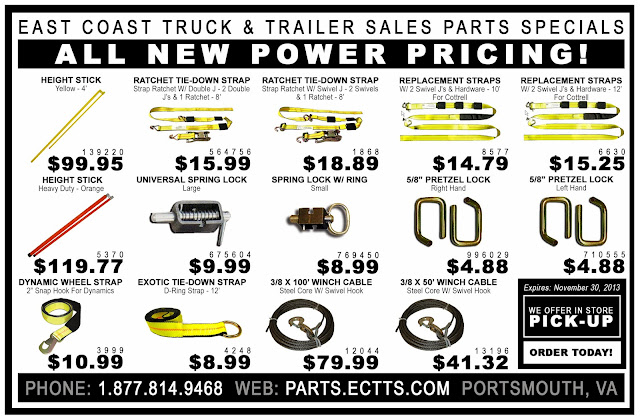
East Coast Truck and Trailer Sales Equipment Specials. Click picture above for parts specials. Click picture below for car hauler deals.
 East Coast Tow and Rollback Trucks


Monday, August 9, 2010

O.B. market says tow notice meets the mark - SignOnSanDiego.com

From Union Tribune
San Diego

O.B. market says tow notice meets the mark


Saturday, August 7, 2010 at 10:08 p.m.


Wednesday afternoons mean no parking on Newport Avenue

Four of Star Towing’s tow trucks idled on the same Ocean Beach block last week, waiting for their usual 2:30 p.m. Wednesday go time, when it becomes illegal to park on Newport Avenue between Cable and Bacon streets.

By 3 p.m., the only two vehicles left on the block had been ticketed, loaded onto the trucks and hauled away to make room for the weekly Farmers Market.

Some Ocean Beach residents complain that signs on the block aren’t prominent enough to fairly warn the usual one or two motorists a week that still get towed, which can cost upwards of $300. But the Ocean Beach Mainstreet Association, which runs the market, says it’s doing the best it can to remind motorists to move their cars.

In addition to about nine permanent signs, OBMA posts about 25 temporary signs — two in each planter box — the morning of the Farmer’s Market, market manager David Klaman said. He walks around with a megaphone reminding people to move their cars, and asks the lifeguards to make announcements from their stations.

He said he thinks putting the signs up in the morning is plenty of advance notice since cars can only park there for two hours anyway.

Sgt. Gary Mondesir, special events sergeant with the San Diego Police Department, said if a group gets a permit to block a city street for an event, they have to notify drivers at least 72 hours before.
Mondesir has been to the street before the Farmers Market and said OBMA goes beyond what they’re required to do, even going into stores and telling merchants to warn their customers.
OBMA Executive Director Denny Knox said the permanent signs take care of the advance-notice requirement, although some motorists may be leaving their cars after a night at the bars and failing to come get them.

Knox said OBMA tried to hire a company just for the Farmers Market that would tow cars for less money, but the city said that was illegal.

“I don’t know what else we could do,” she said. “We feel terrible about it. We don’t want any cars towed.”
But on Wednesday, some pedestrians watching the truck drivers hook up the vehicles remarked that the warning signs were too small or too infrequent.

“What a total scam,” said Sean Ritz, 40, as he watched truck drivers load the cars onto their trucks.
The Mission Valley resident had been nearby at the beach that day. When he saw the vehicles being towed, he had a moment of panic, worried he might have been parked in the wrong block, although he was not. He said he empathizes with those people, who would come back to the block and not find their cars.
“The signs are not enough,” he said. “They aren’t in every space.”

Klaman, the market manager, thinks people either don’t think to read the parking signs when they park or they just forget to move their cars, but he understands the frustration.
“They yell at me saying, ‘Why did you tow my car?’ or ‘You didn’t have the signs up when I parked,’” he said. “I’ve got horror stories.”

Fox Ludwig, 46, who’s been driving a tow truck for Star for four years, said people have told him they forgot to move their cars or they didn’t think the prohibited parking applied to them, he said

Drivers are paid by the hour instead of commission, so he tries to wait until the last minute to pull someone’s car away, though he has to have the street cleared by 3 p.m.

“We make money, but we don’t want to tow anyone,” he said.

Ocean Beach resident Christina Reilly, 54, had her car towed from the block a few months ago. She said she didn’t see any signs when she parked there at 1:30 p.m. to go to a grocery store about a block away. She returned to find a tow-truck driver hooking up her car to his truck.

Reilly said there needs to be more permanent signs and a more consistent policy on where they are.
“There’s too much room for error,” she said. “It’s just discourteous to the public.”
---------------------------------------------------------------------------
V straps on sale
sku 5037
https://parts.ectts.com/index.php/grade-70-v-straps-24-with-15-j-and-t-hooks.html
Regular Price: $69.95
Special Price: $59.95 
-------------------------------


O.B. market says tow notice meets the mark - SignOnSanDiego.com
Enhanced by Zemanta

Thursday, August 5, 2010


Safety safety safety.

I can’t stress this enough.  Too many drivers are getting injured or killed on the highways from numerous things.  The biggest thing that I can stress is BE SEEN!!!  Wear a vest to light up the scene.  There are numerous things you can do.  I remember one time where I was dispatched to a disabled motorist on a toll road.  It was a BMW and came out as a flat tire.  I thought to myself great, this person has never changed a tire before in their entire life and will most likely sit in the car and leave me to the work.  I arrive on the location of the disablement and find that the shoulder was barely enough to have the BMW on the side of the road, let alone my 21’ ford Jerr Dan Rollback.  I saw the disabled car and turned on every light I had so other motorists could see me.  I positioned my truck behind the disabled car so that as motorists came flying by they could see all the lights much better and not slam into us.  I also pulled a page from the police and decided to angle my truck so it gave me a little more room to work, keeping me out of harms way. 
Safety is the biggest thing that we need to follow out there, but so few drivers do.  Wear the safety vest.  Turn on all your lights especially at night.  People can see those work lights and your warning lights. Put extra warning lights on the back of the truck, more than the front.  And if that does not work, flares and triangles are a great tool to keep you safe, whether they are battery powered or the old fashioned ones.

Matt Thompson
Wrecker Division Resident Tower and Jerr-Dan specialist
East Coast Truck and Trailer
2906 Elmhurst Lane
Portsmouth, VA 23701
1-800-849-2178 (toll free)
(757) 465-2200 x336
--------------------------------------------

msaks@ectts.com -


Monday, July 26, 2010

News and Specials from East Coast Truck and Trailer Sales! via @constantcontact

http://myemail.constantcontact.com/News-and-Specials-from-East-Coast-Truck-and-Trailer-Sales-.html?soid=1101539072269&aid=Gzt5TRI4DBw

News and Specials from East Coast Truck and Trailer Sales! via @constantcontact

http://myemail.constantcontact.com/News-and-Specials-from-East-Coast-Truck-and-Trailer-Sales-.html?soid=1101539072269&aid=Gzt5TRI4DBw

Tow-retrieval charge takes a hike in Victoria

Victoria Police DepartmentImage via Wikipedia
Times Colonist July 23, 2010


The cost of getting your car back if it's towed from a Victoria street or parking lot is going up.

Victoria councillors yesterday agreed to a hike in the towing fees companies can charge to $85.50 from $65. The storage fee will increase to $20 from $15.

Fees were last increased in 1995.

Towing companies will also be allowed to charge $33.60 for the use of a dolly in a tow.

The city tows vehicles that are illegally parked on streets or in city lots.

Councillors were told the rate increase is needed for companies to meet increased costs.

Only Coun. Philippe Lucas voted against the increase, arguing he couldn't support it without evidence that the increases were necessary to cover costs.

The increases are designed to bring Victoria rates, which have been among the lowest in the region, more in line with neighbouring municipalities.

Saanich recently increased its tow rate to $75 from $65 and Esquimalt's $65 rate is under review.

Because the Victoria Police Department negotiates its own towing services contract, police-initiated tows can be exempt from the city towing bylaw.

Read more: http://www.timescolonist.com/news/retrieval+charge+takes+hike+Victoria/3312693/story.html#ixzz0unQKBGoU
-------------------


msaks@ectts.com -


Tow-retrieval charge takes a hike in Victoria
Enhanced by Zemanta

Friday, July 23, 2010

Peterbilt 379 for sale

Image via Wikipedia


Peterbilt truck2004 PETERBILT 379 Conventional Truck w/ Sleeper For Sale At TruckPaper.com

Quantity 1
Stock Number 6301
Year 2004
Manufacturer PETERBILT
Model 379
Price Call
Location Portsmouth, Virginia
Condition Used
Sleeper Size 63"
Engine Specs Caterpillar
Engine Type C-15
Horsepower 475
Transmission 13 Spd
Ratio 3.55
Tires 24.5
------------------------
email msaks@ectts.com for more information

Enhanced by Zemanta

Wednesday, July 21, 2010

Diesels make bad dentists

pulled from Toronto Sun
July 21,2010

A Kitchener truck driver is facing a careless driving charge but on the bright side, his tooth doesn’t hurt anymore.

Lambton County OPP say they stopped a big rig driver doing some driving dentistry along Hwy. 402 on Wednesday.

Const. John Reurink told the Sun Saturday it’s the first time he’s ever heard of a driver being pulled over performing dental surgery.

“I’ve never heard of this sort of thing occurring before,” Reurink said, adding he has stopped drivers doing their make-up, reading a map or talking on a cellphone. “Somebody doing an amateur tooth pulling? That’s a first.”

Reurink said it all started June 30 when an officer was on Hwy. 402 in Warwick Township, near Sarnia, and a passing driver pointed him to a tractor trailer being driven “all over the road.”

The officer found the eastbound rig and pulled it over.

Cops determined the 58-year-old driver was driving so poorly because he was trying to pull out a tooth while he was driving.

“The driver was very forthright with the officer,” Reurink said.

The amateur dentist of a driver had rigged a string around his hurting tooth and then tied the other end to the roof of the cab, police said.

“One good bump and the tooth should come out,” police explained.

Turns out the “one good bump” likely did come along at some point.

“The evidence of his efforts were nearby,” Reurink said.

When the driver was stopped the officer found a bloody tooth and a string lying next to him.

Strangely, police say the road down that way isn’t that bumpy and was recently resurfaced.

“He may have been better off on a sideroad,” Reurink said.

Police won’t be releasing the driver’s name because he’s charged under the Highway Traffic Act, not the Criminal Code, and they figure he’d be “continuously bombarded” by media trying to talk to him about his stunt - which would likely be more of a headache than a toothache.
-------------------------------------------------------------------------------------------------------


msaks@ectts.com -


- msaks@ectts.com
Enhanced by Zemanta